The Fountain by Ellison Blackburn
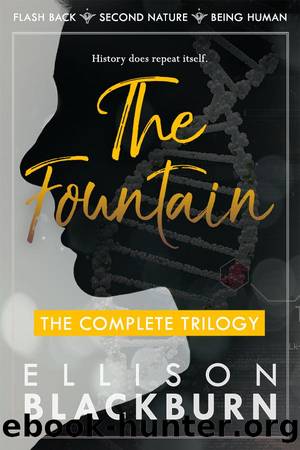
Author:Ellison Blackburn
Language: eng
Format: epub
Tags: science fiction, speculative fiction, women’s fiction, pyschological, drama, contemporary fiction, literary fiction, family saga, genetic engineering, time-travel, contemporary romance, new adult romance
Publisher: Goldbrier Press
Chapter Seventeen
Love is not only the cardinal fact in the individual life, but the most important concern of the community; after all, the way in which the young people of this generation pair off determines the fate of the nation; all the other affairs of the state are subsidiary to that.
âH. G. Wells
ã» ã» ã»
ONE REALITY OF today that I have yet to mention is our lack of population growth. There are nearly one million people across the globeâbut thatâs not very many considering the surface area of the planet. For one thing, over 90% of the population is regens, repeatedly living their youth in ignorance of the fact that there are far fewer people than ever before and there are consequences to that.
A kind of side effect of being a predominantly regenerative people is, subliminally we believe, we have all the time in the world to procreate and, therefore, we generally take longer to find mates. We donât see the effect of decreasing populations day-to-day, and so we carry on as if the only factor in play is our personal choice.
Parents who already have children have them for longer lifetimes and they, too, do not feel the need to continue building their brood of younglings. If an outsider to the concept of regeneration were to walk around our community, she would see there arenât as many children as would be healthy for any society.
One point Liam made was that every time he went to the futureâsince heâd started travelingâheâd taken particular notice of the population sizes of communities and they appear to be getting smaller still. This dilemma led us into a debate over the Progeny Project. Would their goalâto make regeneration a privilege for the fewârestore the balance and inspire people to have more children within a shorter span of time? Aside from the obvious injustice the unprivileged many might feel, itâs something we, as a civilization of individuals, should consider realistically. This school of thought would mean most of us wouldnât have unlimited lifetimes to live. That would make it doubly hard to remain unbiased and rational when considering the argument.
Recently, Iâd met with the possibility that I would not be allowed to regenerate. On that day, losing my right to regeneration seemed inevitable. However, the reality of that fear turned out to be short-livedâa little over a month at most. The Progeny Project is a similar but different beast. For non-progeny, first grasping and then accepting the idea that unless a person could prove his or her worthiness in each lifetime, he or she would face old age and death would be a much larger and grittier pill to swallow.
Cass, with her biblical knowledge, informed us that lifespans were longer thousands of years ago. Moreover, there was no such thing a regeneration science back then. Iâd always thought that was some calendar trick, where the years were greater because the number of days constituting a single year was less. Instead, she explained, according to scholarly works,
Download
This site does not store any files on its server. We only index and link to content provided by other sites. Please contact the content providers to delete copyright contents if any and email us, we'll remove relevant links or contents immediately.
Sita - Warrior of Mithila (Book 2 of the Ram Chandra Series) by Amish(55231)
Crystal Cove by Lisa Kleypas(39298)
The Crystal Crypt by Dick Philip K(37034)
The Crystal Egg by Wells H.G(35687)
We Ride Upon Sticks by Quan Barry(34710)
Crowbone (The Oathsworn Series, Book 5) by Low Robert(33754)
The Secret History by Donna Tartt(19436)
Primed Son (Dark Siren Book 4) by Eden Ashley(18996)
Cat's cradle by Kurt Vonnegut(15525)
Ready Player One by Cline Ernest(15109)
Always and Forever, Lara Jean by Jenny Han(15055)
Norse Mythology by Gaiman Neil(13537)
4 3 2 1: A Novel by Paul Auster(12597)
Crooked Kingdom: Book 2 (Six of Crows) by Bardugo Leigh(12436)
The Betrayed by Igor Ljubuncic(11954)
The Betrayed by Matthew Dickerson(11726)
Scorched by Sharon Ashwood(11390)
The Betrayed: Book one of The Lost Words by Ljubuncic Igor(11318)
Scorched Treachery (Imdalind #3) by Ethington Rebecca(11243)
